Showing posts with label Cutting Edge. Show all posts

Monday, 25 January 2016

Cutting Edge - Rope 1948

Fig 1.
 Alfred Hitchcok's 1948 film Rope is about two men who murder their former classmate. They stuff his body into a chest and then display this chest in the centre of a party that they held, in a way to celebrate the murder. One of the men, Brandon is extremely worried about what they have done and its made clear that he's full or regret and fear. Whereas the other man, Philip is proud of his achievement of taking the life of someone who he believes is 'less superior to him'. As Rodger Ebert said "Convinced they have found a victim who is inferior to them, they murder him, conceal his body in an unlocked trunk in their apartment, and then throw a dinner party with the trunk as the brazen centrepiece of the living room."(Rodger Ebert 1984)
Fig 2.
Throughout the film we can see the development of the two main characters very clearly. From the offset we can already see Brandon feeling fear of being caught and some remorse. Whereas Philip is proud of what he has done, he had a bottle of champagne on ice to celebrate as well as hosting a party at his. At this party it is as if he wants to put his work on display almost. He does this by using the chest which contains the body as a centrepiece table. Almost getting a sexual thrill from what the men have done. During the film we can see the characters moods develop, Brandon drinking more and more to drown his sorrows and Philip making comments throughout the night almost hinting. At one point when they are under suspicion he even puts a gun in his pocket ready to kill again to hide what he has done. " Philip, were he is intelligent as he is portrayed, would surely have realised in an instant what a liability Brandon was, but he simply ploughs on with his scheme of breathtaking arrogance,"(20/20 Films 2012)
Fig 3.
Once of the most noticeable factors of this film is that Hitchcock makes the film appear as if it is one continuous shot by using different camera methods to seamlessly changes scene to make it appear as if the action hasn't stopped. This effect gives you a a real feel for the time and you get a basis of the location that the film is taking place in. Due to this method it means that the film involves a lot of dialogue and at times can become a bit tedious to watch. But Hitchcock uses this to his advantaged to allow the audience to get a full understanding of the characters emotions. We can see that Hitchcock had tried to use the effect of a theatre style of film, as said by Vincent Canby "Hitchcock was interested in seeing whether he could find a cinematic equivalent to the play, which takes place in the actual length of time of the story."(Vincent Canby 1984)
Overall Rope was seen as a experiment for Hitchcock. From the way in which he tried to make a film from a play and shot as if it was a play in real time. This was new for the time and due to the time also had some limitations. Making it difficult to have the continuous shots due to lack of computer programmes for editing. This style of films with the continuous shots is being carried on in today's cinema and is still very successful as we can see from films such as Birdman, which shows Hitchcock's impact in today's film industry.


Bibliography

Ebert. R, RodgerEbert.com - http://www.rogerebert.com/reviews/rope-1948

20/20 Film Reveiws - http://www.2020-movie-reviews.com/reviews-year/1948-movie-reviews/rope-1948-movie-review/

Canby. V, New York Times -  http://www.nytimes.com/library/film/060384hitch-rope-reflection.html

Images

Fig 1 - http://classiq.me/wp-content/uploads/2013/04/rope-1948.jpg

Fig 2 - http://criticsloft.com/wp-content/uploads/2014/01/Rope-pic-1.jpg

Fig 3 - https://robertsnow.files.wordpress.com/2011/08/rope-superior.jpg

Sunday, 10 January 2016

Cutting Edge - La Jetee (1962)


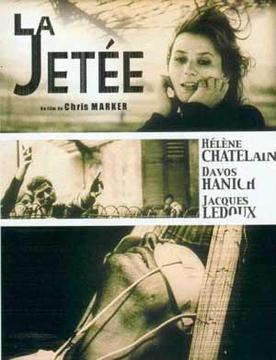
Fig 1.
Chris Markers 1962 film La Jetee is a unique viewing experience when it comes to the film industry. With the story of travelling to the future to try and avoid an apocalyptic World War 3. A film made entirely of still images with dialogue overlaid on top to help portray the story clearer to the viewers rather then having to depict the story solely from the stills. "La Jetée is made up almost entirely of still photographs that tell the futuristic story of a time traveler"(Jeffrey Anderson) The use of this technique makes the film very artistic and is the reason why I believe it was so highly acclaimed. Not only that but it was one of the cornerstone for time travelling films as we can see the ideas portrayed in this film within feature films in modern cinema.

Fig 2.
The main aspect of this film that stands out to the viewers is the continuous use of stills, rather then video footage. Making the film more like a story portrayed through a slide show. As artistic as this technique to produce a film is at times it can be found rather tedious to view as the black and white images are rarely visually stimulating for the viewers making it hard to keep focus at times. That being said there are a number of images that have a lot going on that really makes the viewer feel the emotions that are trying to be portrayed, which can be difficult through the use of this technique. As said by Bosley Crowther "I find it tediously pretentious, but there are striking images in it"(Bosley Crowther)
Fig 3.
When looking at the sound design of this film the main aspect is the narrating throughout. This is used to tell the story and describe what is happening. The images are used more to set the scene and the mood. The narrating at times can be very monotone which can make the viewing experience rather tedious but the use of the dramatic stills takes your attention away from this so it can make it less noticeable at times. As said by Eric Melin "The English translation allowed me to concentrate on the visuals rather than subtitles, but the French version narration is actually quite different."(Eric Melin 2012)
Fig 4. 
Overall La Jetee was a revolutionary artistic film that took a new approach towards creating visual media. Markers used this technique to be something different and to stand out from other films, and he managed to achieve this very well with this unique piece that paved the way for modern time travelling stories. 

Bibliography
Anderson. J 2012 Combustible Celluloid - http://www.combustiblecelluloid.com/classic/lajetee.shtml

Crother, B New York Times - http://www.rottentomatoes.com/m/la_jetee/

Melin. E 2012 Scene Stealer's - http://www.scene-stealers.com/columns/overlooked-movie-monday/la-jetee-sans-soliel-blu-ray-review/

Images
Fig 1 - https://upload.wikimedia.org/wikipedia/en/f/f7/La_Jetee_Poster.jpg

Fig 2 - https://s3.amazonaws.com/criterion-production/stills/3638-17f9fe315ecf2a7fea2c96036271f6ba/P_original.jpg

Fig 3 - https://i.ytimg.com/vi/yqMEc0oe4yc/maxresdefault.jpg

Fig 4 - https://blogger.googleusercontent.com/img/b/R29vZ2xl/AVvXsEhsU51it0h5F_MeiGf0zvhPziVDQJyitRoNIpPZoCPdmIZV3YIFlbjZINh_6vWIFb3yihUitPqrXVe_b0XoKkCLMz8190SkqnOpbH_jca2S8A68hw-RQyVba5XWXf7R68dTYMImY_EiZDA/s1600/La+Jet%25C3%25A9e.jpg